
The Real Cost of Skipping DFM Before Tooling
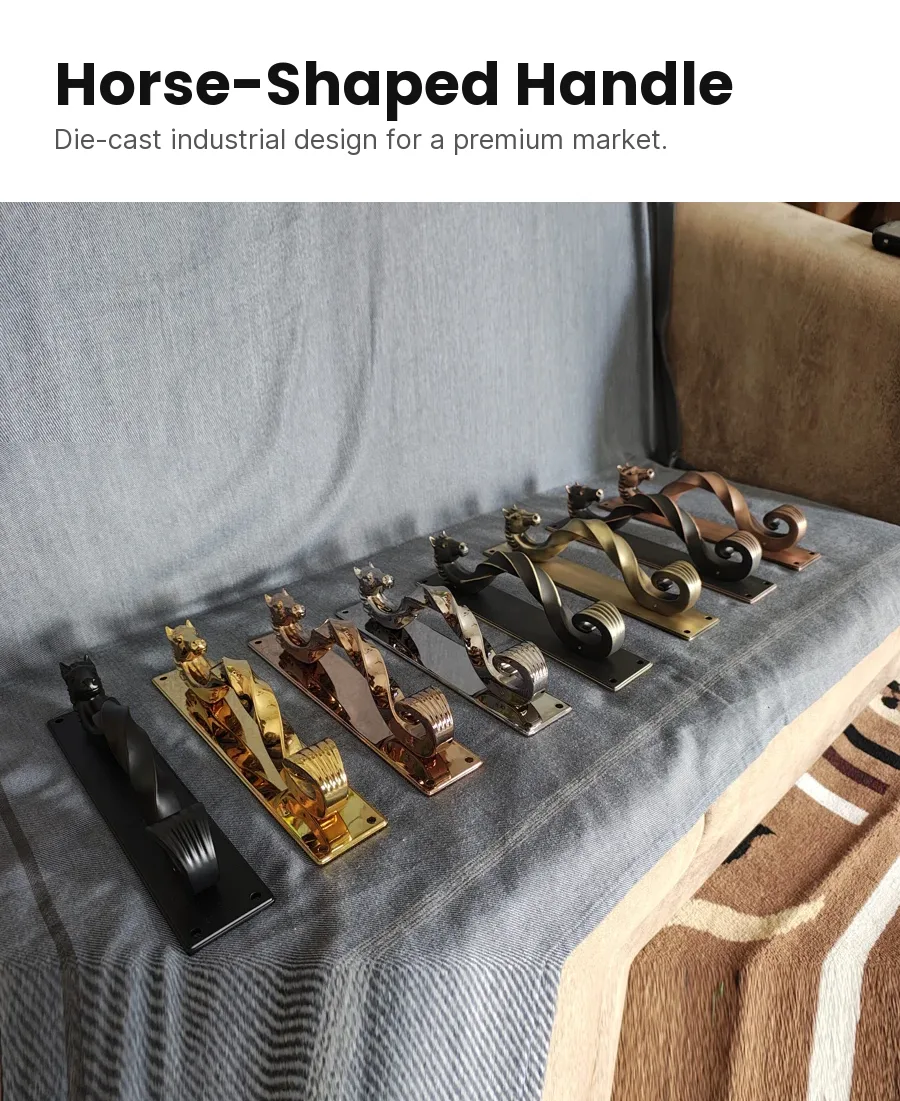
Design for manufacturing is not a formality bolted onto the end of a CAD file. It is the difference between a mold that runs clean on the first shot and one that comes back from the toolmaker with a change-order invoice. The cost of skipping it does not show up in the design phase. It shows up the moment steel gets cut.
A recognizable form still has to release from a die
Our Horse-Shaped Handle project needed a die-cast zinc handle that reads clearly as a horse from multiple angles for a premium USA hardware market, while staying inside what die casting can actually produce: no undercuts a mold cannot release, and no thin sections that would short-shot mid-pour. Sculptural ambition and mold release are two different constraints, and reconciling them before tooling is exactly what a DFM pass is for. Reconciling them after the tool is already cut means a rework bill on top of the original one.
Six variants means the DFM pass has to hold six times over
Our Rotating Wheel Center Caps project needed a snap-fit mounting system compatible across six different wheel diameter variants, with precision bearings integrated into a compact structure. Before committing to that tooling, the team validated the mechanism with SLA 3D-printed prototypes tested on actual vehicles. That step existed specifically to catch a fitment or bearing-clearance problem on a printed part, where a fix costs a design revision, instead of on a production tool, where the same fix costs a re-cut across six cavities.
What a DFM review actually catches
In both projects, the pattern is the same: a DFM pass checks draft angles, wall thickness, undercuts, and mechanism clearances against what the tooling process can physically produce, before that geometry is locked into steel. Skipping it does not remove those problems. It just moves the bill for finding them from the design phase, where a CAD revision is cheap, to the tooling phase, where a mold rework is not.