
Why Working Prototypes Die Before Production
Founders bring us a working prototype far more often than they bring us a working product. The two get treated as the same thing right up until a mold quote, a BOM at volume, or a field-use test proves otherwise. The gap between "it works on my desk" and "a factory can build this reliably, at cost, by the thousand" is what we call the industrialization gap, and it is where most first-time hardware efforts stall.
A demo does not have to survive tooling. A product does.
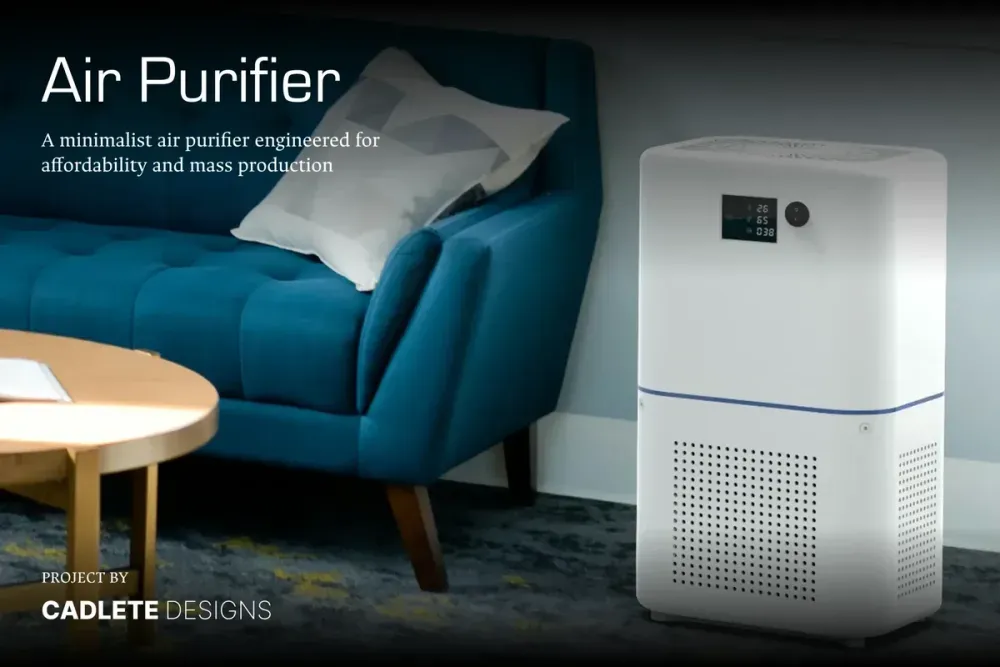
Our Low-Cost Air Purifier project is a clean example. The client had a working concept, but the housing needed to be large and the client needed the unit to hit a mass-market price point. Getting there meant eliminating undercuts entirely from the enclosure design so the injection mold stayed cost-effective, then fitting a full PCB and display system inside a genuinely tight budget without the result reading as cheap. None of that shows up in a bench prototype. It only shows up once someone prices the tool.
Field conditions are a design requirement, not a QA step
Our Ethernet Tester project had to survive an industrial field environment, not a lab bench. That meant engineering wall thickness, draft angles, and assembly fit specifically for injection molding, then adding silicone rubber overmolding for grip and shock resistance without wrecking the housing’s clean look. A prototype that works in a controlled test does not tell you whether the same design survives being dropped on a job site.
Outdoor, multi-year reliability is a different brief entirely
Our Pickleball Scoring System had to work identically across three separate mounting variants, sync wirelessly to a wristband with multiple courts running at once, and survive direct sun, rain, and temperature swings with no expected maintenance for years. That is an enclosure, an electronics architecture, and a firmware problem all engineered together from day one, not a shape refined after the fact.
Closing the gap
The pattern across all three: the prototype stage answers "does this work." Production readiness answers "can this be built the same way ten thousand times, at a real cost, in the conditions it will actually live in." Closing that gap means bringing DFM, electronics architecture, and real-world use conditions into the design conversation before tooling, not after a first mold quote comes back higher than expected.