
Kitchen Knife Attachment: A Simple Tool for Uniform Bread Slices
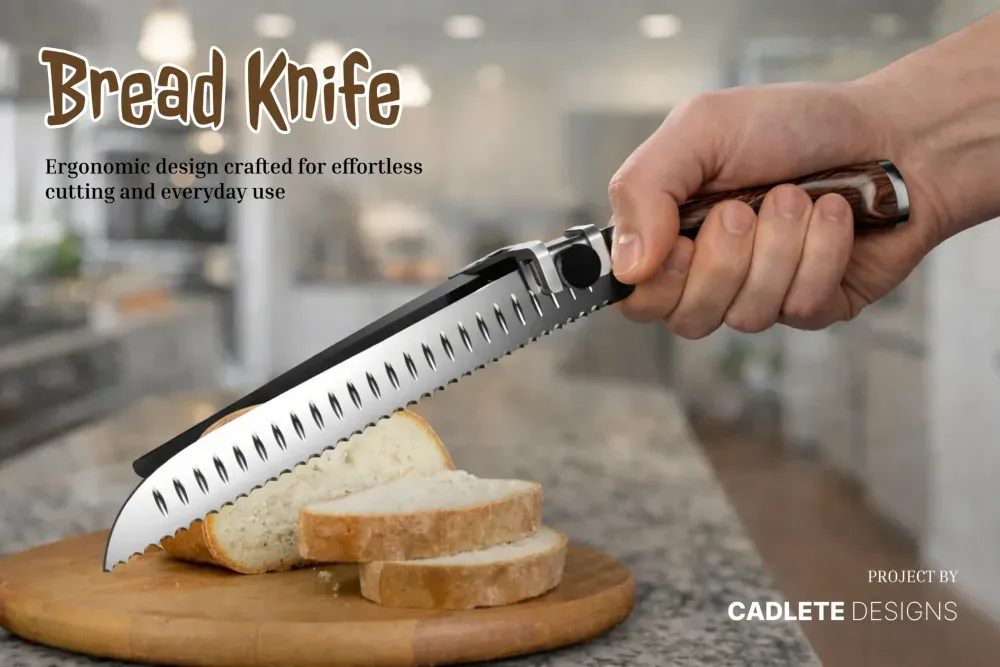
Solving an everyday kitchen problem with a knife guide
Cutting bread evenly with a standard kitchen knife usually means uneven slices, a messy presentation, and unnecessary waste. Our client wanted a universal attachment that guides the knife to consistent slice thickness.
The attachment had to work with common kitchen knives, without special tools or a complicated setup, and be designed from the outset to be manufactured at scale through injection molding.
What made this project hard
Guiding mechanism precision
Controlling slice thickness accurately while letting the knife move freely and keeping the bread stable.
Universal compatibility
Working with common kitchen knives, without special tools or a complicated setup.
Injection molding constraints
Wall thickness, draft angles, and structural integrity all had to hold up under real molding guidelines.
From concept to a validated functional prototype
Four stages, one team, no handoffs between them.
Concept & Architecture
Product architecture developed around the guiding mechanism.
3D CAD for Molding
Detailed CAD modeling optimized for plastic injection molding.
SLA Prototyping
A 3D-printed proof of concept built to test the mechanism.
Functional Validation
Prototype tested for real slicing accuracy and consistency.
Concept and functional architecture
The attachment’s core architecture was developed around guiding the knife to a consistent depth, the mechanism the rest of the product was built to support.
Injection-molding-ready CAD from the start
The design followed injection molding guidelines from the first CAD model, with wall thickness, draft angles, and structural integrity built in rather than fixed later.
3D printed proof of concept
A 3D printed proof of concept was produced to validate the mechanism physically before moving to a full functional prototype.
Functional prototype and testing
The functional prototype was tested for accuracy, producing consistently even bread slices even at the prototype stage, well before tooling investment.
What shipped
"The functional prototype successfully demonstrated the product’s accuracy, producing consistently even bread slices even in the prototype stage."
Questions We Hear About This Project
Why 3D print a proof of concept before building the functional prototype?
A 3D printed proof of concept let the core guiding mechanism be validated physically at low cost before investing in a full functional prototype build, catching a bad mechanism decision early rather than late.
How does a simple attachment stay compatible with different kitchen knives without extra tools?
The core architecture was built around guiding the knife to a consistent depth using the knife itself as the cutting tool, not a proprietary blade, which is what keeps it universal without a complicated setup.
Was the CAD built for injection molding from day one, or adapted later?
From day one. Wall thickness, draft angles, and structural integrity followed injection molding guidelines starting with the first CAD model, not fixed after a prototype-only design was already locked.
Have a kitchen product to bring to production?
Free 30-minute consultation. A real engineer reads your brief, not a bot.