
Designing for Pet Product Brands: Five Real Projects, Five Different Engineering Problems
Pet products sound like a single, simple category from the outside: bowls, beds, and grooming tools. Once you have engineered a handful of them, the differences matter more than the similarities. Five real projects from our own work show how differently the same broad brief can play out once you get into materials, stability, and the actual animal using the product.
A stability problem: the Custom Pet Feeder Bowl
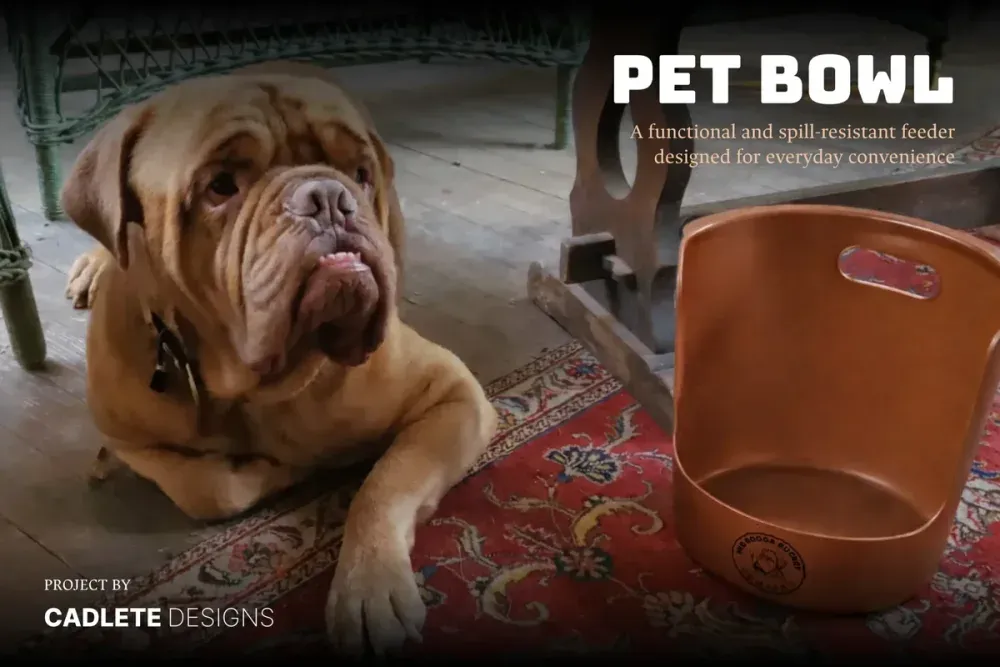
Our Custom Pet Feeder Bowl case study started with a market gap: almost no feeder bowls were designed for the size and strength of large breeds like Bull Mastiffs, so bowls got shoved around, spilled, and displaced during feeding. The fix was not a bigger bowl, it was an overmolded bowl with integrated metal dead weight at the base and a durable rubber anti-skid layer bonded to the bottom, engineered through overmolding so the metal-plastic bond held up over time. Branding on the curved surface even needed its own solution, since standard screen printing and UV methods were not reliable on that geometry. The client’s response after launch was strong enough that they expanded the line to cover every dog size, and cats.
A litter problem: the Baby Bottle Kitten Bed
A very different feeding problem showed up in the Baby Bottle Kitten Bed, a circular station that holds up to eight bottles at once so a caregiver can bottle-feed a whole litter of baby animals simultaneously instead of one at a time. The round shape keeps the animals close together near the caregiver, and bottles are held in place with Velcro straps so hands are free for other tasks. The measured result was a feeding time cut by more than half for anyone handling a litter or a group, which mattered enough to animal breeders and shelters that it justified the product on its own.
A durability problem: the Bird Feeder
Our Bird Feeder case study is a reminder that “simple” pet products can still be a materials problem in disguise. Built in food-grade stainless steel with a lifetime guarantee, the design had to survive permanent outdoor exposure without rusting, without degrading the food inside, and without needing the kind of replacement cycle that plastic feeders usually go through. The engineering effort there is invisible in the finished product, which is exactly the point.
A grooming mechanism problem: the Pet Flea Glove
A pet flea glove we developed for a USA pet product manufacturer needed to combine two things that do not naturally go together: a comfortable grooming surface and an effective way to catch fleas during that grooming. We went through industrial sketching to explore shapes, textures, and features before settling on a final design, then delivered manufacture-ready files, 3D CAD models, technical drawings, and full specifications, so the client could move straight into production. The interesting part of that project was never the glove shape, it was getting the texture and mechanism right so grooming and flea removal happened in the same motion.
An anti-spill problem: the Elevated Pet Feeder
An elevated pet feeder we designed for dogs and cats needed to solve a problem every pet owner recognizes: bowls that slide or tip during eating and drinking. The answer was a rotating clip mechanism that securely holds the bowls in place at an elevated height that also improves posture for the animal while eating, built from a combination of wood and plastic for a stable, removable, easy-to-clean structure.
The takeaway
None of these five products share a single engineering solution, even though they all sit in the same retail category. A stability problem, a volume-feeding problem, a durability problem, a grooming-mechanism problem, and an anti-spill problem each needed a different material, a different mechanism, and a different manufacturing process. Treating “pet products” as one design brief is how you end up solving the wrong problem.